Montgomery County Poets Laureate

The Annual Montgomery Poet Laureate Competition is the foundation upon which the MCPL Program was built. The competition is the ultimate expression of the program’s mission; creating an ever expanding community of poets, supporting their work and providing opportunities for poets to elevate their visibility while also benefiting the community with their service project, many of which continue long beyond their tenure.
How does the competition work?
Each year MCPL recruits a celebrity poet with a national reputation, who along with two additional local Delaware Valley poets, adjudicate the submitted manuscripts.
The newly selected Montgomery County Poet Laureate is honored with an award in the amount of $500 along with a personalized statement about their work, which is shared through MCPL and other local organizations.
The Award is presented during an Award Ceremony and Reading, open to the public and attended by the celebrity judge and previous poets laureate to read with and welcome the newest member of their esteemed ranks.
Who can compete?
Poets of all ages and backgrounds are encouraged to submit their poetry for review and adjudication in the annual competition. Poets must also be residents of Montgomery County. The window for submissions generally opens in early December and closes mid-February with the winner to be announced at the end of March.
The role of the Poet Laureate
The Poet Laureate functions as an ambassador for poetry in Montgomery County from April 1 of the year of his/her naming to March 31st of the following year. This role includes working with MCPL’s Executive Director, Joanne Leva, to develop a schedule of readings, workshops
Appearances may include the Forgotten Voices Poetry Group, Farley’s Bookshop First Thursday Poetry Reading Series, and the annual Caesura Poetry Festival. They may also hold the office of “
Why Poets Write | by Melinda Rizzo
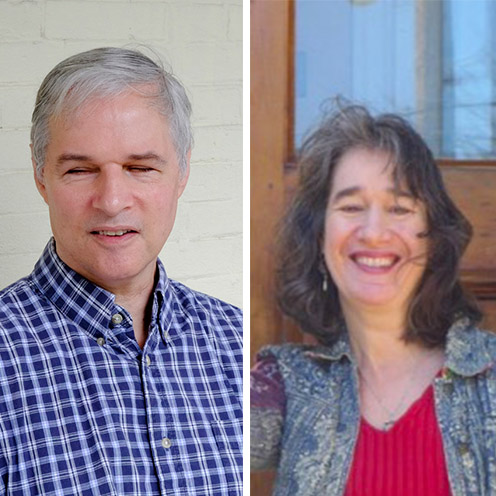
Why Poets Write: An interview with Ona Gritz and Dan Simpson
It’s tempting to write about the big things.
Throughout time poets have been reliable historians – think The Epic of Gilgamesh from about 2100 BCE – it’s among the oldest surviving great literary works. Poets are creators of chronicles – from the Greek, (annals of time) and they’re often the conscience of a moment, place or culture. Poets take things down, record and process ideas and feelings. They use various literary devices to do this. Sometimes they use no devices, because poetry is like that. Poets sift and sort through sense and memory, and they use poetry in its various forms to create a framework in which to know themselves and to share with others.
“I write poetry because I can’t help it,” said Ona Gritz, whose love of language “drives all.”
For Gritz and Dan Simpson, both poets living in Lansdowne, Delaware County, writing poetry is as essential as breathing. Simpson said the poetic form allows him to explore his knowledge, feelings, ideas and those “things I believe and the things I don’t believe” in a way unlike any other. Recently, he reflected on the climate and landscape of the Sept. 11, 2001 terrorist attacks in New York City and elsewhere in the U.S., noting the similar feel of the global coronavirus pandemic.
Again, poets are here. Simpson said it’s hard to write about something in a meaningful way while you’re enduring it. Writing about it may not be the answer, yet. “Writing about a pandemic in the middle of a pandemic, or about racism, which are huge current events right now, is difficult,” he said. But for poets the work goes on, in one form, shape or another. Simpson said poets should allow themselves time, space and compassion – knowing eventually the page will fill again.
If you’re a poet who waits for inspiration, consider these tips:
- Continue, start, or find a small writer’s group to join
- Work with a poetry mentor
- Revise, revise, and revise again. Going back to older work and even considering revision can be useful, freeing and prompting more work (and it’s an antidote to the “blank page”)
- Avoid isolation by finding other ways to safely connect – virtually, in nature, through reading
- Read anything and everything
- Find balance by trying out a different genre like memoir, non-fiction, fiction, etc.
- Write in a different poetry form than the usual and familiar to “kick start” the writing process
- Consider writing prompts to find community and company when being alone becomes lonely or feels isolating
For many, writing poetry is not an optional endeavor. Simpson writes poetry to explore “the big questions like love and death.” He said working from biblical texts is another way he discovers faith and takes a hard look at fact. “I write poetry in order to get to know my mind. To find out what I think, it’s kind of a spiritual practice,” Simpson said. While he takes a poetry break, Simpson is exploring memoir writing and said that will help fuel new poetic work when the time is right.
Gritz said writing poetry becomes an exercise in “deep listening” along with the power to search for truth. “In my writing [now], I’ve moved more towards prose lately. Writing is like breathing, and I definitely need to be working on something,” she said.
For those seeking inspiration consider More Challenges for the Delusional, edited by Ona Gritz and Daniel Simpson developed by Peter Murphy and available on Amazon and at Diodeeditions.com.
At Diode Editions at https://www.diodeeditions.com/product-page/more-challenges-for-the-delusional
No Results Found
The page you requested could not be found. Try refining your search, or use the navigation above to locate the post.
Poets Laureate